The GIFT OBE framework consists of basic four steps to implement the system including Design, Assessment, Analysis, and Review. For each step, there is some defined process that helps to evolve the Program Educational Objectives (PEOs), Program Learning Outcomes (PLOs), and Course Learning Outcomes (CLOs).
The first phase in the OBE framework is the design phase. To define the PEOs, the vision and mission are kept in mind. Once the PEOs are formulated, program specifications are defined that define the structure of the program. The curriculum is designed by the BoS and the curriculum is reviewed by CRC to incorporate new technological advancements.
GIFT EED is using PEO’s defined PLOs. The next step is to design the detailed course outline that contains PLOs, CLOs, Bloom’s taxonomy, and teaching and assessment methods. A complete checklist is attached to Annex-M. The teaching assessment methods are defined such that all the CLOs defined in the lesson plan must be evaluated.
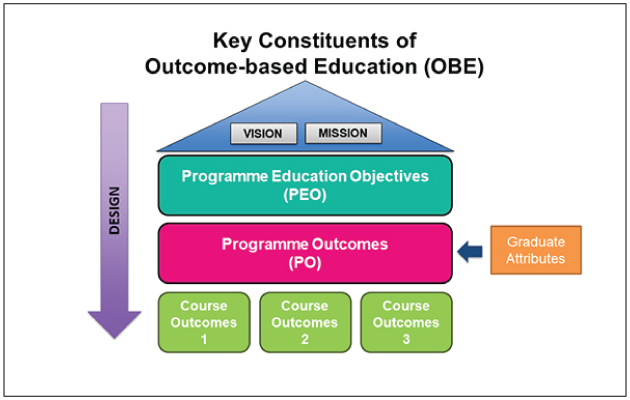

The second step is to assess the design outcomes and objectives, using measurable methodologies. GIFT EED is utilizing multiple assessment types and techniques to assess the designed OBE system. Complete details are available in chapters three and four.
PEO assessment is carried out using Employers’ Feedback and Alumni Feedback. The curriculum assessment and revision are also carried out by a committee of senior faculty members and is completed at required intervals for fulfillment of PLOs. Moreover, CLOs assessment results determine the fulfillment of PLOs. However, CLOs assessment results of respective courses are used as a direct assessment for the achievement of PLOs throughout the program. CLO attainment report is generated through MS Excel sheets, manually, at the end of each semester.
The third step is to analyze the performance and feedback and take necessary measures to improve the standards of the system. The PEOs, PLOs, and CLOs are reviewed to ensure that the teaching and assessment methods are aligned with the outcomes. The analysis involves reviewing the feedback collected from employers, alumni, and students, along with the assessment results.
Based on this analysis, required revisions to the curriculum, course contents, and assessment strategies are identified. Corrective actions are planned and executed to continuously improve the program and ensure alignment with the intended outcomes and industry demands.

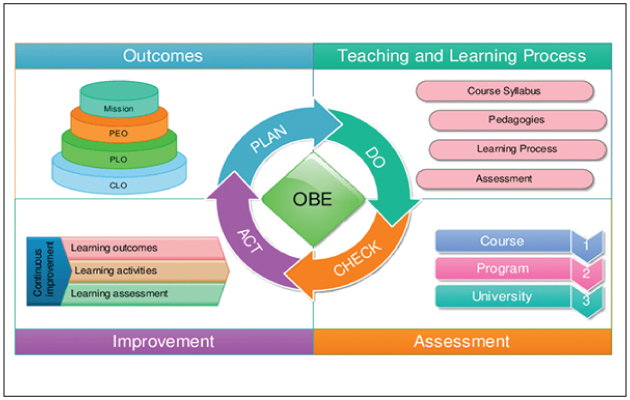
The fourth step is to review and to evaluate key changes in the system to ensure continuous improvement. The outcome of analysis and any required implementation of corrective actions are done. Moreover, course outlines may get some revision as well.
Electrical Engineering Department, at GIFT University, has defined the Program Educational Objectives (PEO) according to its mission, University’s mission, and industry demands. After the Electrical engineering program students should be:

Able to understand and grasp industrial problems and devise effective solutions using the latest technology.
Capable of working as a team lead/member with effective communication and interpersonal skills.
Display ethical and mature character with high moral values, positive attitude, responsible behavior, and virtuous vision.
The Department of Electrical Engineering has adopted the graduate attributes, as defined in EAB Manual 2014, and these are supported by our defined PEOs.
An ability to apply knowledge of mathematics, science, engineering fundamentals, and specialization to the solution of complex engineering problems.
An ability to identify, formulate, research literature, and analyze complex engineering problems, reaching substantiated conclusions by using the first principles of mathematics, natural sciences, and engineering sciences.
An ability to design solutions for complex engineering problems and design system components, or processes that meet specified needs with appropriate consideration to public health and safety, cultural, societal, and environmental factors.
An ability to investigate complex engineering problems in a methodical way including literature survey, design and conduct of experiments, analysis, interpretation of experimental data, and synthesis of the information to derive valid conclusions.
An ability to create, select and apply appropriate techniques, resources, and modern engineering and IT tools, including prediction and modeling, to complex engineering activities, with the understanding of limitations.
An ability to apply the concept of reasoning informed by the contextual knowledge to assess societal, health, safety, legal and cultural issues and the consequent responsibilities relevant to professional engineering practice and solution to complex engineering problems.
An ability to understand the impact of professional engineering solutions in societal and environmental contexts and demonstrate knowledge of and need for sustainable development.
Apply ethical principles and commit to professional ethics and responsibilities and norms of engineering practice.
An ability to work effectively, as an individual or in a team, in multifaceted and/or multidisciplinary settings.
An ability to communicate effectively, orally as well as in writing, on complex engineering activities with the engineering community and with society at large, such as being able to comprehend and write effective reports and design documentation, make effective presentations, and give and receive clear instructions.
Ability to demonstrate management skills and apply engineering principles to one’s own work, as a member and/or leader in a team, to manage projects in a multidisciplinary environment.
An ability to recognize the importance of, and pursue lifelong learning in the broader context of innovation and technological developments.
A tabular illustration of PLOs vs. PEOs mapping is given in Table.
| Program Learning Outcomes (PLOs) | PEO 1 |
|---|---|
| 1 Engineering Knowledge | ✓ |
| 2 Problem Analysis | ✓ |
| 3 Design/Development of Solutions | ✓ |
| 4 Investigation | ✓ |
| 5 Modern Tool Usage | ✓ |
| 6 Lifelong Learning | ✓ |
| Program Learning Outcomes (PLOs) | PEO 2 |
|---|---|
| 1 The Engineer and Society | ✓ |
| 2 Environment and Sustainability | ✓ |
| 3 Individual and Team Work | ✓ |
| 4 Communication | ✓ |
| 5 Project Management | ✓ |
| 6 Lifelong Learning | ✓ |
| Program Educational Objectives | PEO 3 |
|---|---|
| 1 The Engineer and Society | ✓ |
| 2 Environment and Sustainability | ✓ |
| 3 Ethics | ✓ |
Join GIFT University to be a part of a internationally acclaimed Best University in the region renowned for delivering transformational education with an ethical and entrepreneurial mindset, fostering socio-economic development and creating a positive social impact. With a diverse array of academic programs, GIFT University offers generous scholarships, financial assistance, interest free loans, and very competitive fee structure to support your educational journey. Apply now to book your space as seats are limited!
Apply Online